News

Stainless Steel Outdoor Rainproof Distribution Box Assembly

2026-10-22 0 Leave me a message

Stainless Steel Outdoor Rainproof Distribution Box Assembly

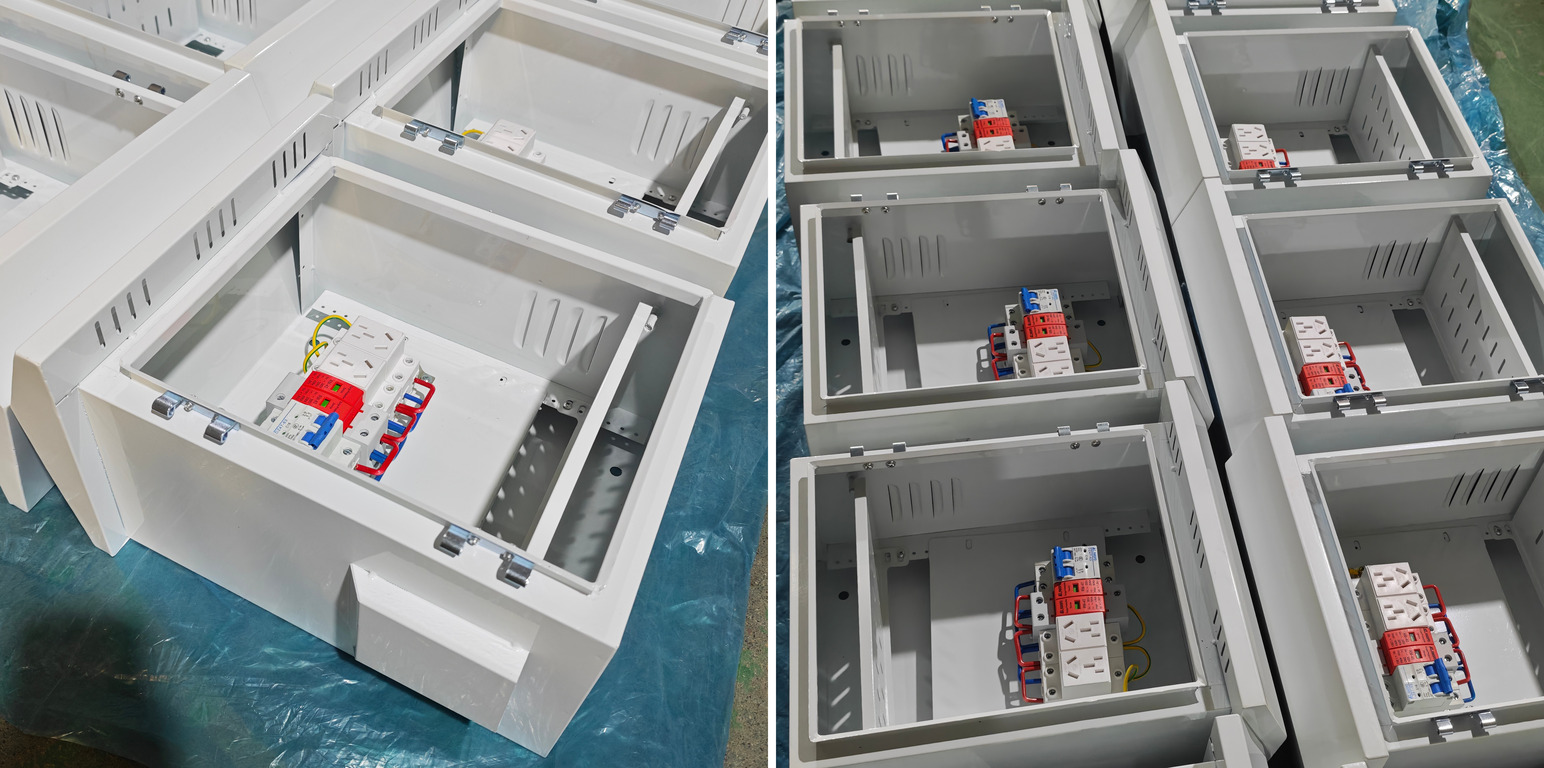
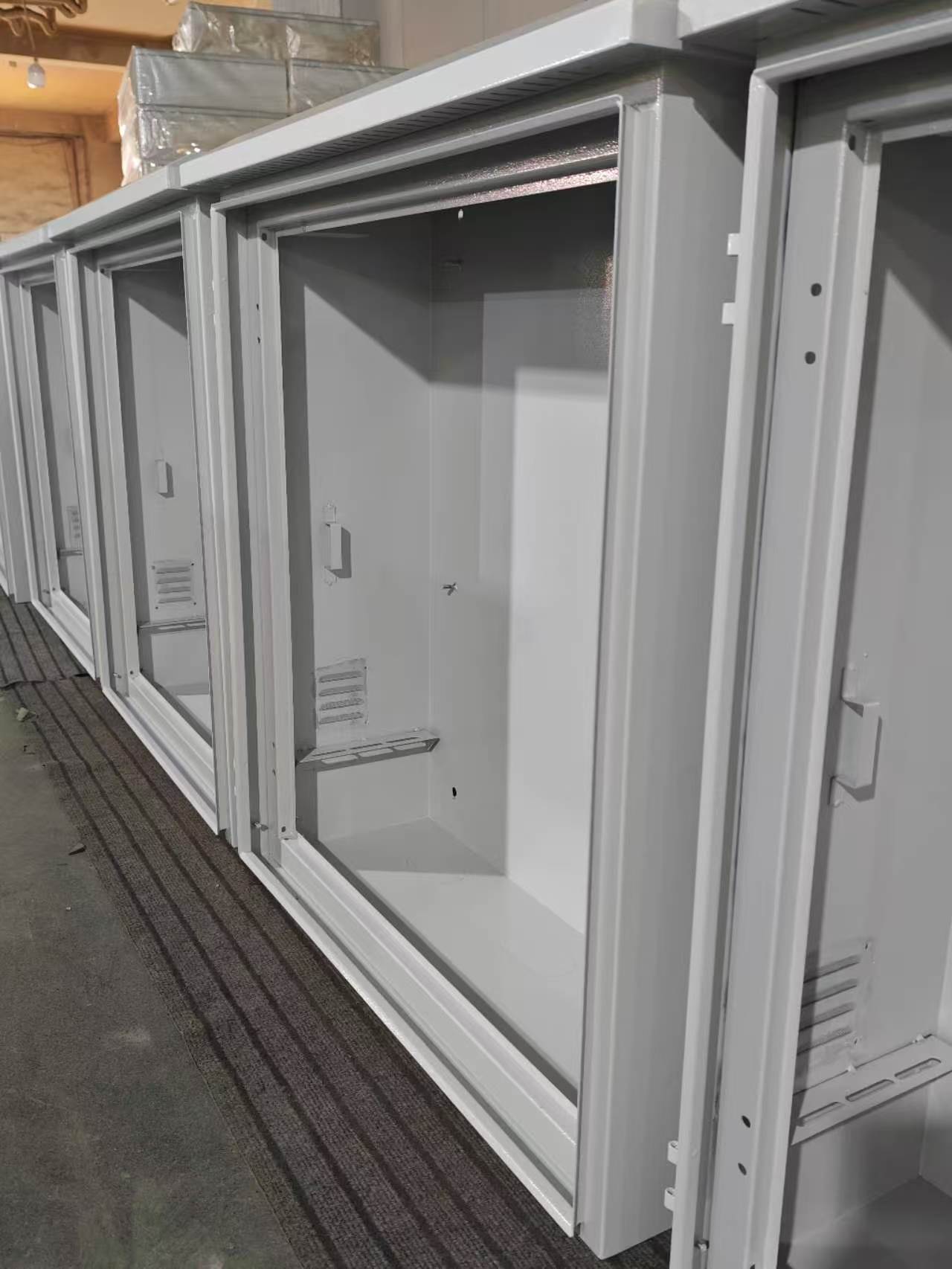
Six boxes sit side by side on the assembly bench with the doors off, and the interiors of a stainless steel outdoor rainproof distribution box lie open to view. Components on the rail, wires folded along the walls and a divider panel closing off a separate cavity show three working zones at the assembly stage. The notes below follow the photographs in order.


One Rail Carries the Main Circuit

A standard DIN rail is fixed high on the back plate. The miniature circuit breaker with the blue handle sits at the left end, the surge protective device with the red body sits directly to the right of the breaker, and the socket modules close the run at the rail end.

Three component types share one rail, so the enclosure needs no separate cut-outs for each device, and assembly follows the drawing from left to right. A short length of rail stays free at the end, leaving room for one more circuit later without stripping the existing devices.

A gap stays open between the breaker and the surge protective device. The surge protective device raises case temperature briefly while clearing a lightning current, and space on both sides limits the heat load on the neighbouring breaker. The same gap gives a torque wrench a straight approach to the terminal screw, so tightening does not foul the next device.

A Divider Keeps Incoming Cables Apart

A vertical divider panel closes off a separate cavity at one side of the stainless steel outdoor rainproof distribution box. Incoming cables enter through the base, are clamped inside the cavity, and are then split into the component zone.

The divider separates terminals from live devices, so hands work inside one compartment during service and the chance of touching a neighbouring circuit drops. Panel height matches the side wall, the door gasket face stays clear, and no part of the panel intrudes into the space behind the door.

Neither photograph shows a door fitted, and the hinge brackets already sit screwed to the lower front rail. Components and wiring are fixed first, and the door goes on at a later station.

Red, Blue and Yellow-Green Wires

Red wire leaves the top of the breaker on the live path, blue wire folds along the wall to the neutral terminals, and yellow-green wire runs to the earth terminal alone without lying parallel to live or neutral. Three colours stay separate inside the enclosure, so a service engineer reads the circuit from colour instead of testing every core.

A bend at each corner keeps a radius rather than a crease. A radius holds the insulation off the folded sheet edge, and vibration over years is less likely to mark the sheath.

Rain Hood and Bottom Hinges

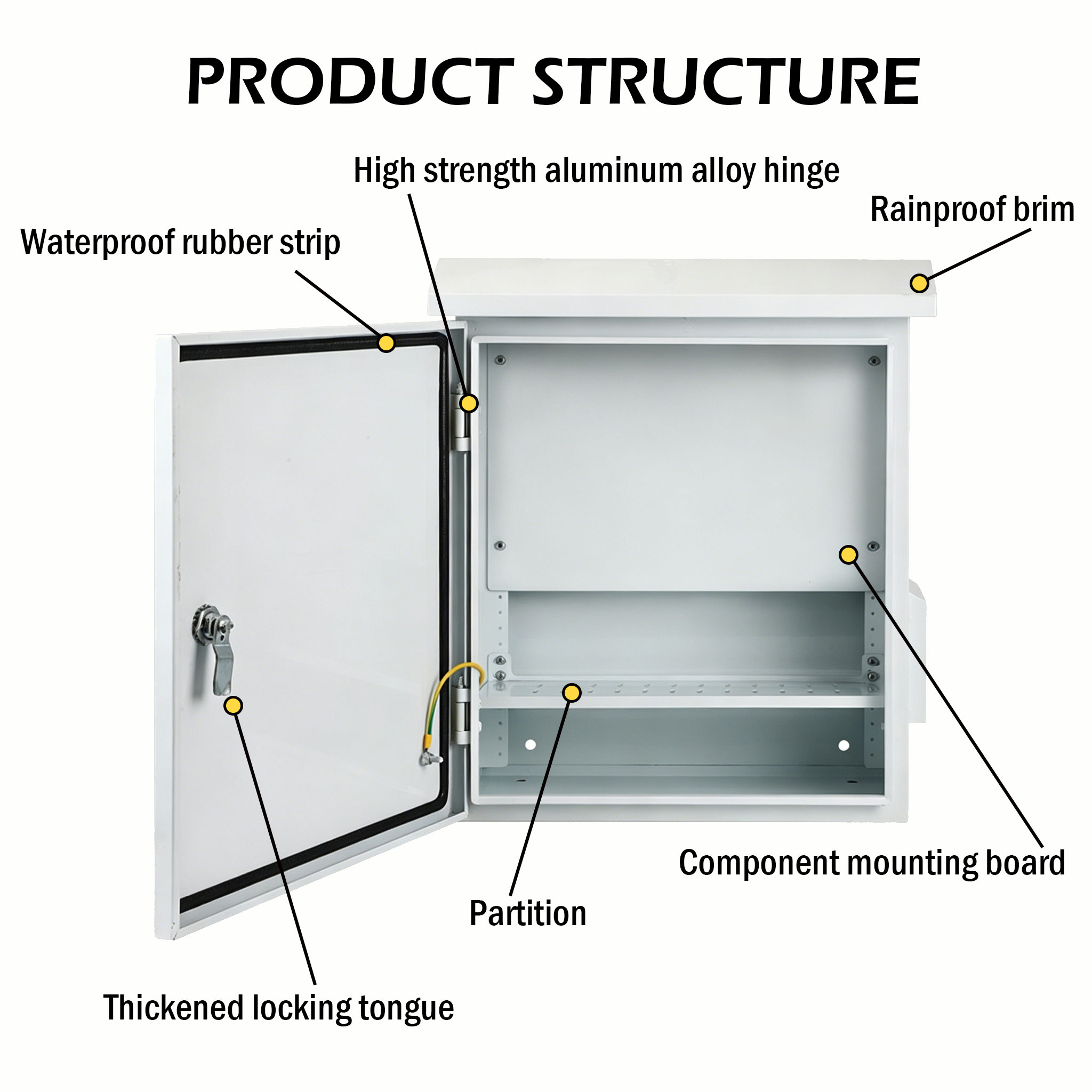
The hinges sit on the lower front rail, so the door swings down. In rain, an open door hangs face down, water runs off the outer panel, and nothing tracks back along the door gap into the enclosure. A top-hinged door works the other way: the panel lifts and forms an upward channel holding water against the gasket.

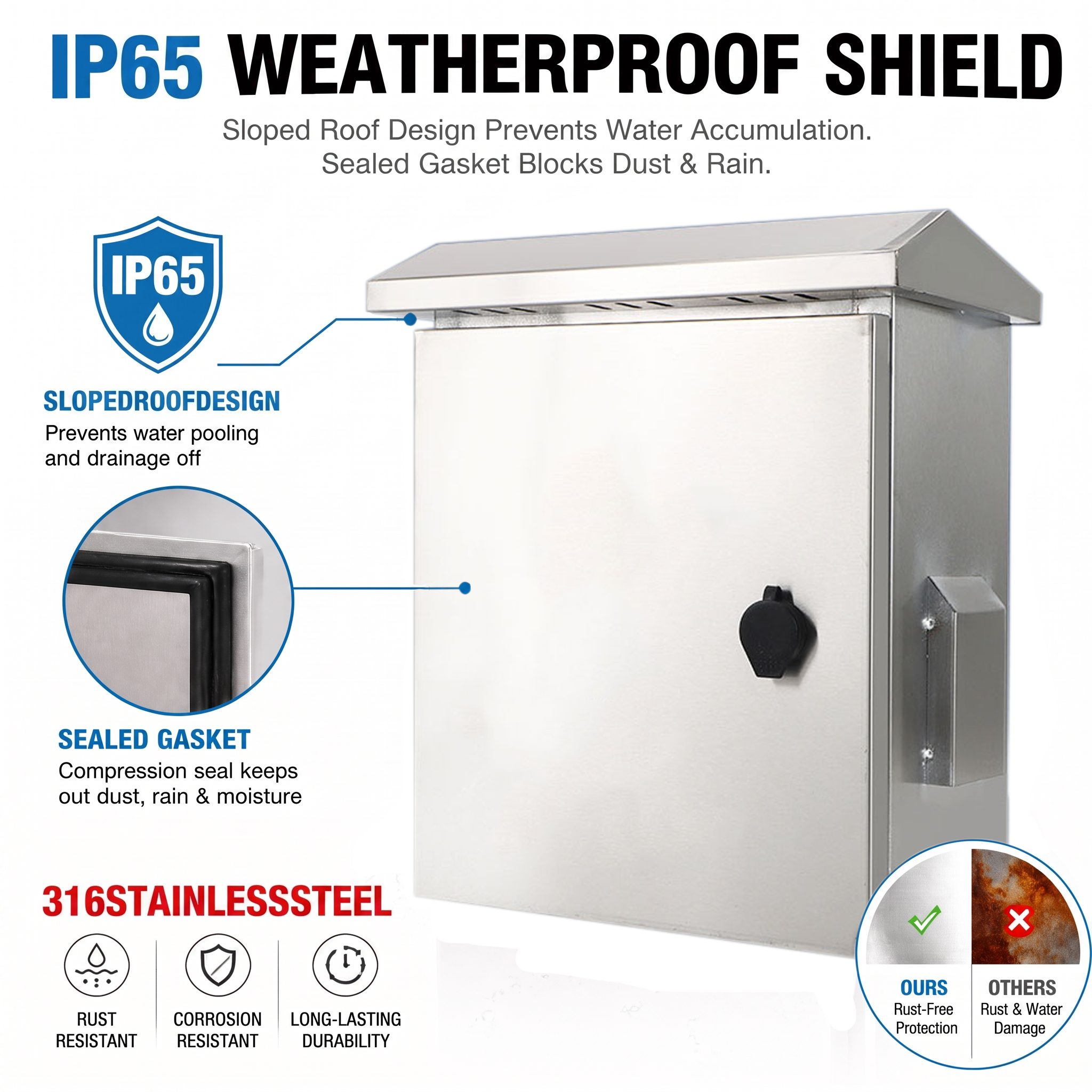
At the top, a hood projects forward past the door plane. Rain drips from the hood edge at a point clear of the gasket line, so the front of the door gap takes no direct rain. Hood projection scales with enclosure height, and a taller stainless steel outdoor rainproof distribution box needs a deeper hood or driven rain still reaches the gasket.

Louvres Formed in the Wall

Louvre slots on the side wall are formed straight into the sheet, with blades turned inward and openings facing down. A formed louvre needs no separate vent cover, adds no rivet holes to the wall, and removes one joint from the enclosure. Water ingress on an outdoor box rarely starts in a flat panel; seams and screw holes are the usual path.

From outside, inward-turned blades show as narrow slots angled downward. Rain runs down each blade, and wind-driven rain finds no straight path into the box. On the stainless steel outdoor rainproof distribution box, louvre area follows the heat load of the installed devices, with spare capacity for a fully loaded breaker and surge protective device.

Three Points Known to Fail at Assembly

Terminal torque. Breaker and surge protective device terminals are tightened to the figure printed in the device instructions. Low torque raises contact resistance and the terminal runs hot under load. High torque crushes strands, and a broken strand hides under the insulation.

Wiring clear of the gasket. A wire crossing the door frame face holds the gasket off the metal, and the protection rating fails at the gasket line. Wiring keeps a set distance inside the frame, and nothing rests on the sealing face.

Frame flatness and gasket compression. A frame welded out of flat leaves part of the gasket unloaded, and a spray test shows water at the door gap. Flatness is controlled at welding; assembly can only compensate through gasket compression, and compensation has a limit.

Six Parts and What Each Does

Part Visible in the photos Effect outdoors
Top rain hood Projected forward and angled down Drip line stays clear of the gasket
Door hinges Fixed to the lower front rail, door swings down Open door sheds rain along the outer panel
Side louvres Formed in the sheet, blades turned inward Ventilation without a direct rain path
Vertical divider Closes off a separate wiring cavity Incoming cables stay off live devices
Rail and devices Breaker, surge protective device and sockets in one run Circuits sit together, service path stays short
Wire colours Red, blue and yellow-green kept apart Live, neutral and earth read at a glance

Materials and Delivery

Zhejiang Ouyue Electric Co., Ltd. is located in Liushi Town, Wenzhou, Zhejiang. The stainless steel outdoor rainproof distribution box takes a body in mild steel, 304 stainless steel or 316 stainless steel, with protection ratings available in IP54, IP55, IP56 and IP65.

CE certification is in place, drawings are machined to order, and the minimum order is 10 units. Internal devices follow the customer drawing, with breaker brand, surge protective device rating and socket standard confirmed at order. Send the drawing for a quote.

Related News
Leave me a message
X
We use cookies to offer you a better browsing experience, analyze site traffic and personalize content. By using this site, you agree to our use of cookies. Privacy Policy
RejectAccept