Industrial Info Resources, citing data from the United States Energy Information Administration (EIA), reports operational battery storage capacity of 43.6 GW at the end of 2025. Operators added another 8.3 GW in the first six months of 2026, reaching nearly 52 GW of nameplate capacity, and grid operator plans indicate an additional 54 GW by the end of 2028. Annual growth in battery storage across the United States averaged 70% from 2023 to 2025.[1]
The project pipeline is equally aggressive. Industrial Info Resources tracks 1,083 BESS projects in the United States with a total installed value above $441 billion planned between the third quarter of 2026 and the fourth quarter of 2028.[1]
Buildout at the current pace pushes outdoor energy storage cabinets into salt fog, wind-blown sand, industrial dust and long rainy seasons. Polinovel, a BESS integrator, stated in an August 2026 selection guide: ingress protection is only one of six areas requiring verification, alongside corrosion resistance, thermal performance, moisture control, interface integrity and installation quality.[2]
IEC 60529 splits the protection of an outdoor energy storage cabinet into two numerals: the first covers solid particles and the second covers liquids.[4] The first numeral runs from 0 to 6. IP5x is dust protected, permitting limited dust ingress provided equipment operation is unaffected, while IP6x is dust tight and permits no dust ingress. For high-voltage battery racks, IP6x is the safer choice because conductive dust accumulation shortens creepage distances.[3]
The water scale is non-linear. IPx4 resists splashes from any direction, IPx5 resists low-pressure jets from a 6.3 mm nozzle, and IPx6 resists high-pressure jets from a 12.5 mm nozzle at 100 litres per minute, which is the standard for robust outdoor battery containers.[3]
The boundary matters. An IP code certifies what a single enclosure achieved under standard laboratory test conditions, not what a cabinet will hold on a specific site.[3]
The first gap sits in the seals, not the metal enclosure. Eco Green Energy, a French solar manufacturer, describes the mechanism: salt fog in coastal regions and industrial pollutants degrade seal materials such as EPDM or foam long before the metal enclosure fails. An IP rating does not measure chemical resistance, and a degraded seal surrenders the rating at an invisible ingress point.[3]
Polinovel reaches the same conclusion. A cabinet can remain sealed and still deteriorate externally, because coastal air, persistent humidity, industrial contaminants and incompatible exposed hardware all shorten enclosure life.[2]
The second gap comes from temperature swings. A summer thunderstorm hitting a hot cabinet creates an internal vacuum, actively pulling moisture through gaskets, so a gasket which repels standing water fails against pressure differentials.[3]
The third gap sits inside the cabinet. Even a perfectly sealed enclosure suffers internal condensation once the dew point is reached.[3] Polinovel lists moisture control as a separate dimension and requires condensation control to be engineered with sealing and thermal design rather than added as an accessory after installation.[2]
Polinovel recommends additional review of enclosure materials, coating systems, exposed hardware, fasteners, connectors, cable interfaces and maintenance requirements on coastal projects, and asks suppliers for the design basis or qualification evidence used for the corrosive environment instead of a generic "outdoor rated" claim.[2] ISO 12944-2 addresses how the corrosivity of a principal environment is classified for painted steel structures.[2]
Documentation to request includes the base enclosure material, the coating or surface-treatment specification, the material used for hinges, fasteners and latches, the treatment of welds, edges and penetrations, corrosion test or qualification information, instructions for repairing damaged coatings, and inspection requirements for connectors and exposed interfaces.[2]
The choice between 304 and 316 follows site salt exposure rather than price: 316 for coastal and desalination sites, 304 for inland industrial environments. Seal material and replacement procedure belong in the technical agreement as well, because salt fog and pollutants degrade EPDM and foam.
Tighter sealing makes cooling harder. Battery racks, power conversion components, busbars and controls all generate heat, and direct sun and high ambient temperature add further load.[2] The mainstream engineering compromise pairs filtered forced-air cooling with a deeply gasketed enclosure, balancing cost against weather protection; moving to full sealing removes passive airflow paths and typically forces liquid cooling at higher cost.[3]
In a ventilated design, insect mesh and louvred vents break the overall seal, so fine sand and high-pressure water jets pass through the mesh. Protection for such a configuration should be stated honestly as IP54 or IP55 rather than claimed at a higher level.
An outdoor energy storage cabinet specification should translate the site environment into verifiable items rather than treating "weatherproof" as a single line. The table below lists what to verify and what evidence to request for each site risk.[2]
| Site risk | What to verify | Evidence to request |
| Wind-driven rain and dust | Ingress protection of the final cabinet configuration | Applicable IP documentation, test evidence and installation conditions |
| Coastal or corrosive atmosphere | Materials, coatings, fasteners and exposed interfaces | Material specification, coating system and corrosion qualification |
| High ambient temperature or direct sun | Cooling performance and derating conditions | Operating envelope, design assumptions and alarm or shutdown limits |
| Condensation and temperature cycling | Humidity control strategy | Sensor locations, humidity limits, control logic and maintenance requirements |
| Cable entry | Glands, entry plates and approved penetrations | Interface drawings and manufacturer installation instructions |
No single rating fits every project. IP55 and IP65 represent different levels of protection under IEC 60529, and a higher numeral does not automatically mean a better system design; thermal management, condensation control, serviceability and actual site exposure all need evaluation.[2]
Condensation forms inside. A fully sealed enclosure condenses moisture on internal surfaces once internal temperature reaches the dew point, so hydrophobic membrane vents, dehumidification or managed ventilation are needed alongside the seal.[3]
Seal material and replacement. Salt fog and pollutants degrade EPDM and foam seals, and a supplier unable to explain how sealing components are inspected and replaced has an incomplete weatherproofing strategy.[2][3]
No. For projects in the United States market, UL 9540 covers energy storage systems and equipment at the system level, while UL 9540A is a test method for evaluating thermal runaway fire propagation. Certification requirements and installation codes depend on the specific project and market.[2]
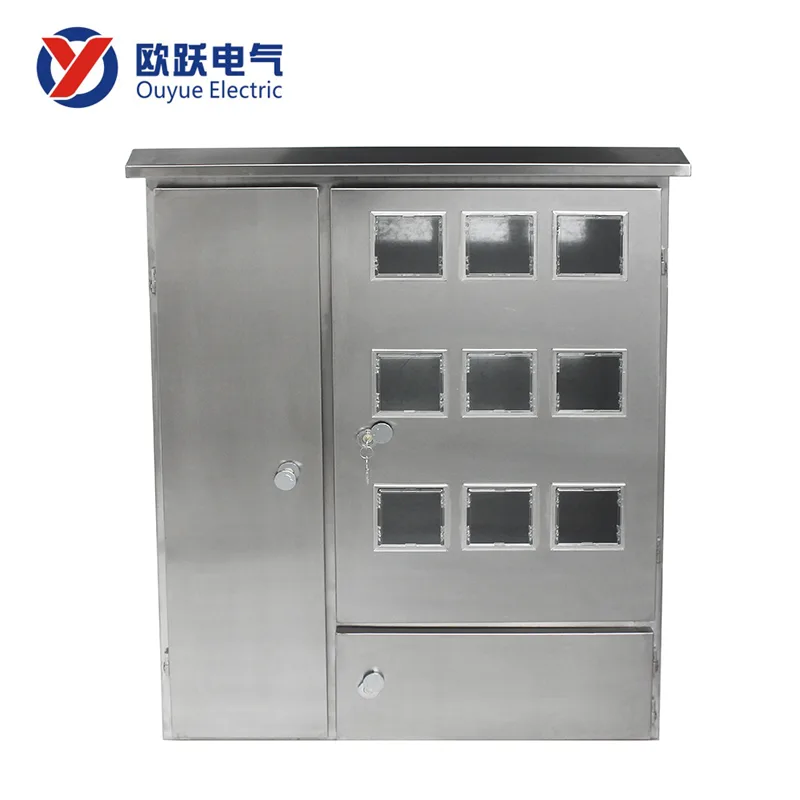
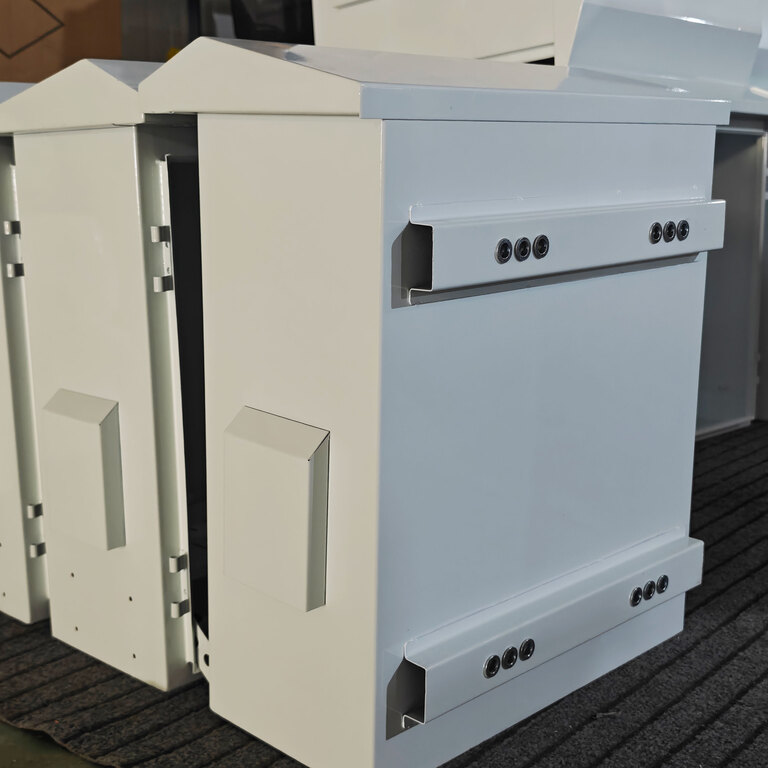
Ouyue Electric builds distribution boxes and cabinet enclosures to drawing in iron and 304 or 316 stainless steel, with protection ratings available in IP54, IP55, IP56 and IP65 and CE certification, from a minimum order of 10 pieces with batch delivery.
For coastal or high-humidity projects, include site salt conditions, ambient temperature range and cable entry method in the enquiry so the technical team can confirm the material and the protective structure for the outdoor energy storage cabinet.